








How One System Builds Skin Health Across Every Skin Type — The Science Behind Complexion Code

Dr. Juan Camilo Calderon
Medical Doctor
Monday,

Products:
Table of content: What you will learn
Listen on the Go
Listen Time 6 mins
The premise of Complexion Code Plus System is not a marketing claim. It is a clinical hypothesis, validated by how the system was designed: not for a single skin type, a single condition, or a single season, but for the full biological diversity of human skin.
This final blog of June explores that hypothesis — how six products can address the full spectrum of skin health variables across every Fitzpatrick type, hormonal stage, environmental context, and treatment objective.
The Universal Biology of Skin Health
Despite their visible diversity, all skin types share the same underlying biological architecture:
- A barrier composed of lipids, proteins, and water that regulates hydration and immune defense.
- A melanocyte population that produces pigment in response to UV, inflammation, and hormonal signals.
- A fibroblast population that synthesizes and remodels the collagen and elastin matrix.
- A network of antioxidant enzymes and molecules that neutralizes oxidative damage.
- An inflammatory regulatory system that modulates immune responses and tissue repair.
What varies across skin types is not the architecture — it is the sensitivity, reactivity, and default state of each system. Fitzpatrick I skin has a low-melanin, high-UV-sensitivity state. Fitzpatrick VI skin has a high-melanin, lower-UV-damage state but higher PIH risk. Hormonal skin has elevated melanocyte stimulation. Post-acne skin has elevated inflammatory baseline.
A system designed to address these shared biological mechanisms — rather than targeting surface manifestations — will naturally serve every skin type. That is the design principle of Complexion Code.

The Six-Product Architecture
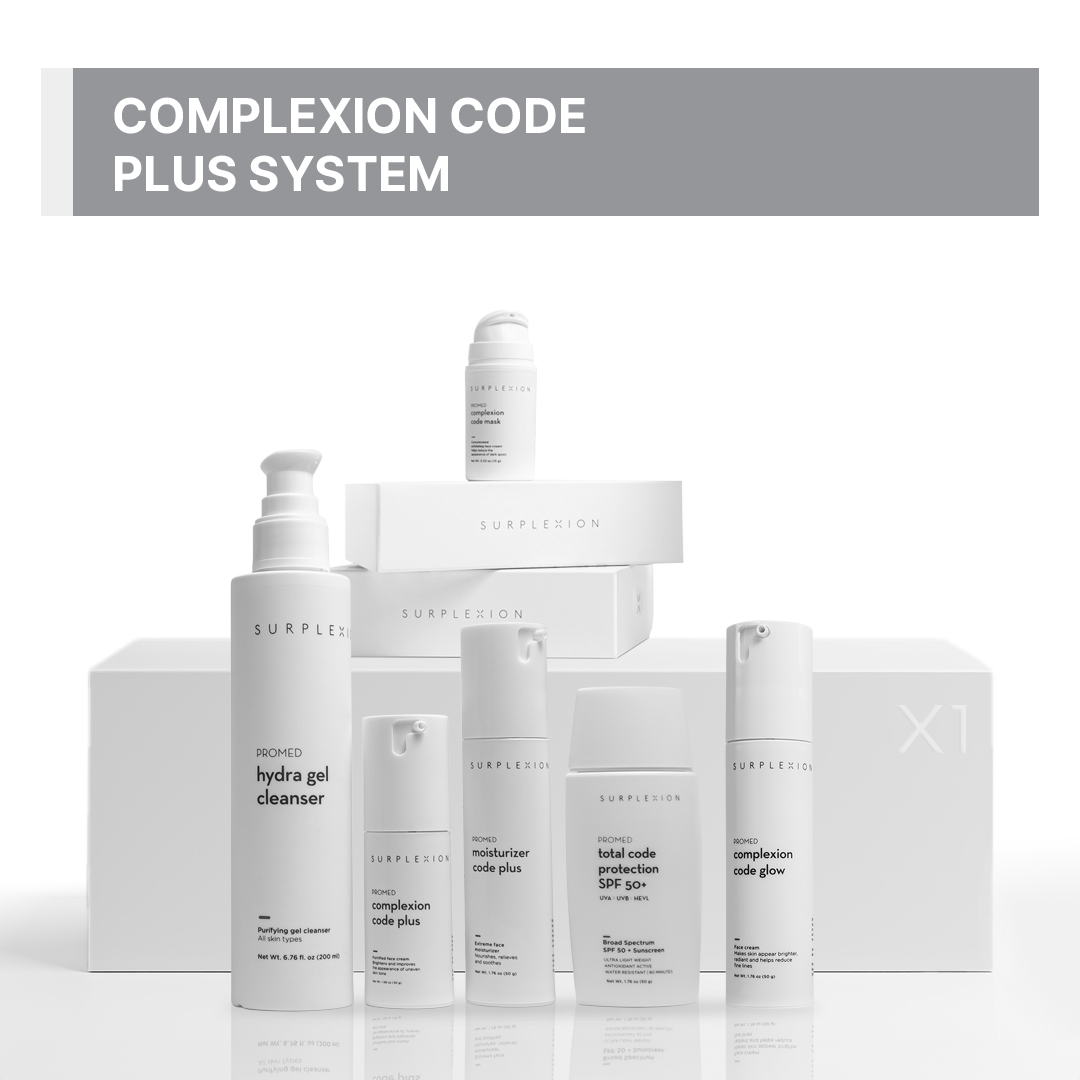
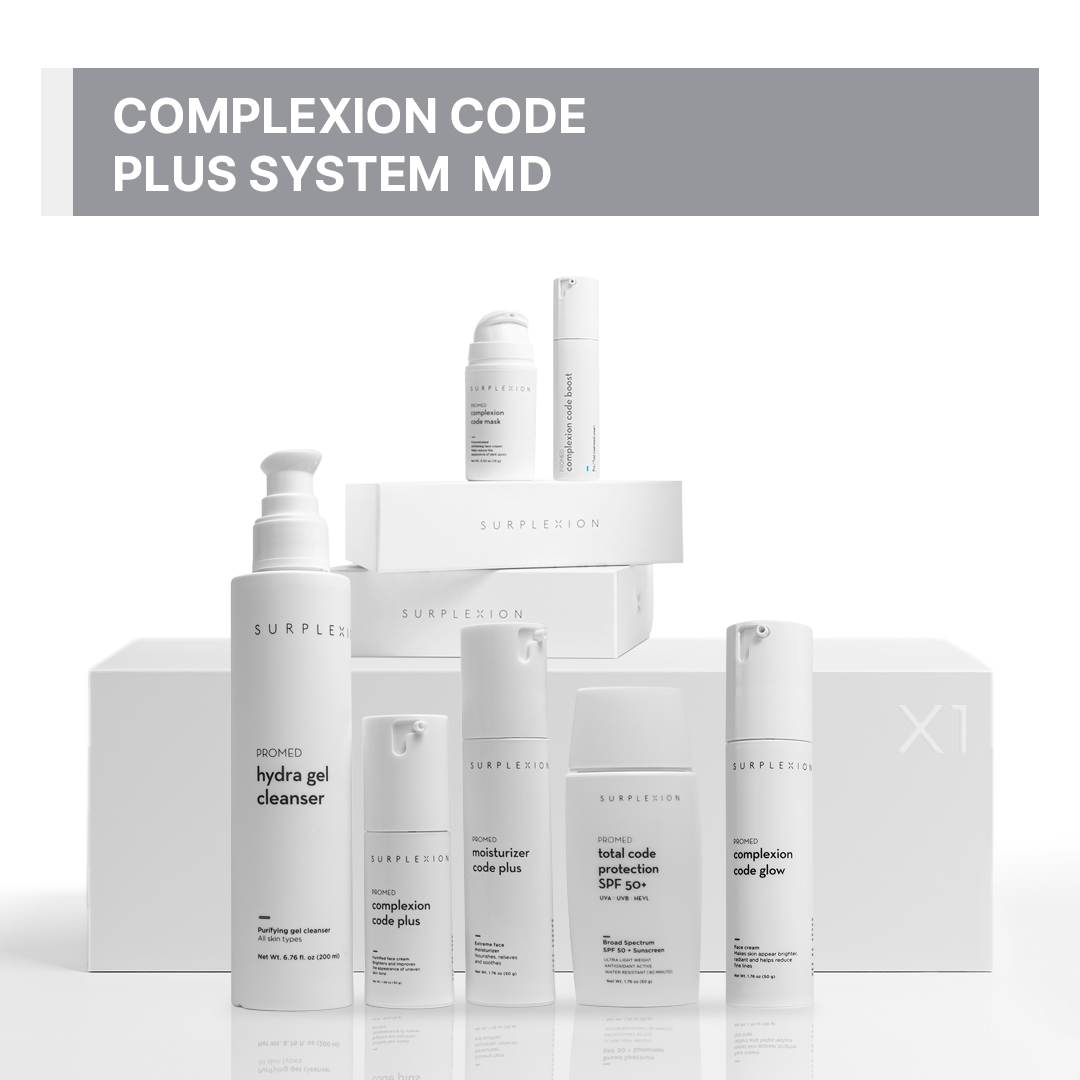
Hydra Gel Cleanser — The Foundation
Physiological cleansing that preserves barrier integrity while removing impurities, sunscreen, and environmental residue. In every skin type, cleansing is the first clinical decision of the day: a cleanser that disrupts the barrier sets every subsequent product up for reduced efficacy. Hydra Gel Cleanser is the stable foundation the system requires.
Complexion Code Glow — The Antioxidant Engine
17 antioxidants with nanosomes delivery address oxidative stress — the universal driver of skin quality degradation. Regardless of phototype, hormonal status, or treatment history, every skin generates free radical burden from UV, pollution, and metabolic activity. Complexion Code Glow reduces that burden progressively, creating the biological environment in which every other product performs better.
Moisturizer Code Repair — Barrier and Hydration
Barrier support is not a Fitzpatrick-specific need — it is universal. TEWL increases with UV exposure, heat, and environmental stress in every skin type. Moisturizer Code Repair maintains the structural hydration and lipid matrix integrity that skin quality requires, regardless of whether the primary concern is pigmentation, firmness, radiance, or texture.

Total Code Protection SPF 50+ — The Daily Shield
Photoprotection is the most evidence-based anti-aging intervention in dermatology. Total Code Protection SPF 50+ delivers it with additional clinical depth: antioxidant defense against the full exposome, niacinamide for melanosome inhibition across phototypes, and anti-inflammatory prevention that reduces the UV-triggered signals that drive both aging and pigmentation.
Complexion Code Plus — Skin Quality System
The homecare centerpiece of the system: 20+ synergistic actives addressing depigmentation, anti-aging, barrier reinforcement, and cellular renewal simultaneously. Suitable for all Fitzpatrick types with progressive application — the multi-mechanism approach means that what each skin needs most, it receives, while the actives it doesn't need in high concentration are present as complementary support.
Complexion Code Mask — The In-Office Reset
14 medical-grade depigmenting agents — tranexamic acid, arbutin, kojic acid, phytic acid, and more — that reset the epidermal baseline in a single in-office session. Functions as the clinical anchor of the system: periodic resets that accelerate homecare results and create the patient-return trigger that builds long-term clinical relationships.

Why One System Works for Every Patient
The Complexion Code Plus System is not a one-size-fits-all protocol. It is a precision system that each patient's biology calibrates automatically through the mechanism of progressive response: the skin takes from each active what it needs and modulates the rest through its own regulatory systems.
The professional's role is to calibrate dosing, frequency, and combination based on individual patient assessment — but the underlying system remains the same. This is the clinical efficiency that one system enables:
- One inventory investment serves the full patient base.
- One training protocol covers every consultation.
- One clinical argument applies to every patient conversation.
- One result — better skin quality — delivers across every skin type.
Preparing for What Comes Next
Establishing this baseline creates a powerful clinical foundation. Professionals who implement the Complexion Code Plus System provide their practice with something far more valuable than a standard product inventory: a patient base that is biologically stabilized, clinically educated, and prepared for advanced treatment protocols.
As new formulations and targeted innovations—such as specialized infusion therapies—are integrated into practice, they serve as the logical continuation of what Complexion Code has established. Rather than introducing disjointed product launches, clinicians can offer a seamless evolution for patients who have already committed to their long-term skin health.
Order the Complete Protocol


Dr. Juan Camilo Calderón
Medical Doctor
All protocols validated by Juan Camilo Calderón, MD — XTETIC Medical Director. A physician trained in Dermatology and aesthetic medicine immunology. He is also a professor, scientific consultant, international speaker, and dermatology publication reviewer.


